












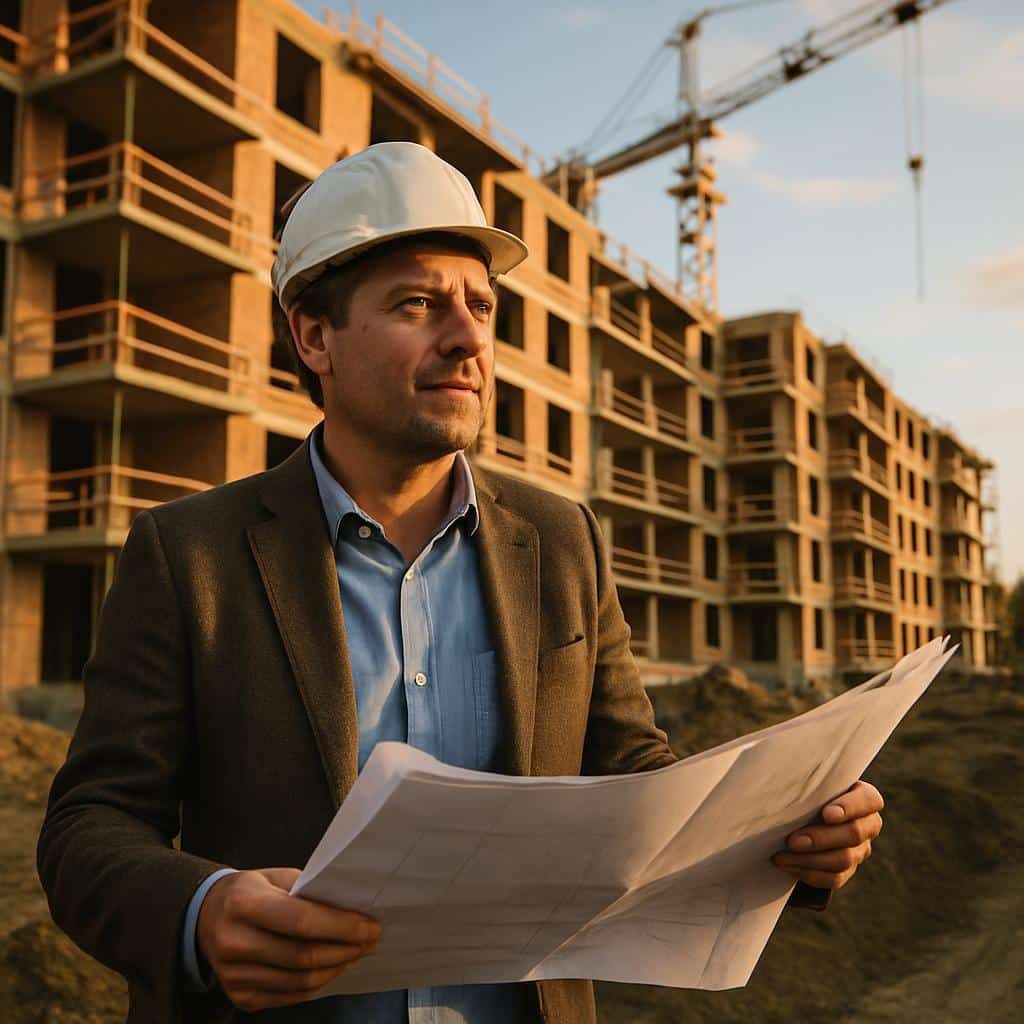



Prioritising residential construction: Federal government ignites turbo for faster new construction projects
Good news for developers, investors and local authorities: housing construction is being prioritised politically. With a bundle of acceleration measures - from digital building applications to type approvals for serial construction - the path from idea to ready-to-occupy property should be significantly shorter. For the property market, this means that projects that have been stuck in approvals for a long time can start more quickly, cost risks are reduced and marketing and letting phases are brought closer together. As a professional estate agent, we will guide you through this change - with market knowledge, project vision and reliable marketing channels.
What will change in concrete terms?
The announced new construction turbo is aimed at reducing bureaucracy, speeding up planning and strengthening the economic viability of residential construction projects. Many steps require cooperation between the federal and state governments; some measures are already being implemented, others will follow gradually. The core principle: housing is a priority - and this should be directly reflected in shorter procedures, standardised processes and lower holding costs.
- Priority for residential construction in proceedings: When weighing up planning and approval, residential projects should be dealt with more quickly - especially if planning law is in place or can be created through simple plan amendments.
- Digital building application: Standardised, digital submissions are intended to reduce media disruptions, minimise subsequent claims and shorten processing times. The aim is to create an end-to-end digital file including audit trails.
- Type approvals/serialised construction: Pre-tested, repeatable construction and modular concepts (series/system construction) can be approved more quickly across national borders. Result: less planning risk and predictable construction times.
- Harmonisation of technical standards: Where state building regulations differ, there will be greater standardisation. This makes work easier for planners and investors with supra-regional portfolios.
- Facilitate change of use: Vacant office or retail space is easier to convert into residential space - especially in locations with adequate access and parking space concepts.
- Densification & roof extension: Construction in existing buildings is privileged in order to quickly create additional units on existing plots.
- Tax incentives and funding framework: Degressive depreciation and KfW programmes (e.g. climate-friendly new build) support economic efficiency - important in the face of higher interest rates and construction costs.
What does this mean for owners and investors?
Shorter approval times reduce pre-financing costs and capital investment without cash flow. In many projects today, there are 12-18 months between the purchase of land and the start of construction. Realistically, digitalisation of processes plus serial solutions shortens this period by several months, depending on the location and complexity (assumption). In day-to-day marketing, every month counts: faster completion means earlier rental income, less interim financing and better planning of sales windows.
Quick check: Time is money
A 6-month acceleration saves around € 45,000 in interest with € 2.0 million interim financing (4.5 % p.a.). In addition, rents flow earlier: 12 residential units at € 1,100 cold each bring in around € 79,200 in 6 months. Together, this results in a liquidity advantage of around € 124,200 - enough to partially compensate for higher construction prices.
Three steps to pick up speed now
Those who are prepared benefit first. The following measures can be initiated in the short term and are suitable for accelerated procedures:
- 1) Check planning law - minimise conflicts: Is building law in place (B-Plan, §34 BauGB)? Are there any critical requirements (noise protection, parking spaces, monument protection)? Early clarification with the building authority saves weeks of additional claims.
- 2) Submit digitally in full: Checklist for building application, preliminary structural calculations, fire protection concept, sound insulation, drainage - all consistent and in the required file structure. The error rate is reduced, as is the inspection time.
- 3) Check serial/modular construction: Type-approved systems or modular extensions speed up realisation. Even for medium-sized projects (< 40 units), synchronisation can bring considerable time advantages.
Typical errors & solutions
- Error: Late verifications (fire protection/sound) → Solution: Preliminary review with specialist planners, use sample documents from the authority.
- Error: Unclear parking space/mobility concepts → Solution: Plan mobility mix (car/bike sharing, proof of public transport) at an early stage.
- Error: Imprecise area divisions → Solution: Consistently prepare marketable floor plans with NUF/NRF and target rents.
- Error: No alternative offers → Solution: Compare two to three serial systems (costs, construction time, energy standard).
Practical example: Densification instead of new construction on greenfield sites
Two storeys are to be added to an existing property with two storeys and a flat roof. The advantage: access, pipes and foundations are already in place and the construction time on the site is predictable. Four units can be built per floor using type-tested modules; assembly takes just a few weeks. Compared to a completely new building, parts of the development and a new development plan are not required. Approval and construction time together can be reduced by several months (depending on the local authority and load assumptions) - with less disruption to the neighbourhood. For marketing, this means faster pre-letting and letting, fewer vacancy phases between completion and first occupancy.
Keeping an eye on risks - managing them professionally
Acceleration does not mean arbitrariness. Inspection capacities at the authorities, noise and fire protection requirements, utility connections, construction costs and energy standards remain key factors. A clean project start amortises itself: transparent cost calculation, reliable construction scheduling with buffers, early marketing strategy (e.g. pre-letting quotas, target groups) and clear lines of communication with the municipality. The ESG perspective is also important: sustainable building products, serial construction with lower grey energy and flexible floor plans increase value retention and exit options.
Project check & initial consultation
We check your project for authorisation, timetable and marketing opportunities - concretely, discreetly and quickly. Request an appointment now: Contact form
Conclusion: The priority push for residential construction uses the right levers: standardised processes, digital applications and serial solutions. Those who prepare their documents in a verifiable manner, consider a modular construction method and set up a clear marketing strategy at an early stage reduce risks and gain valuable months. Talk to us - we will accompany you from the concept to the first letting.