











Car-Free Property Photos: How AI Ensures Berlin Estate Agents Get the Perfect First Impression
In Berlin, the initial glance at a property portal often decides whether interested parties will click, call, or scroll on. However, amidst the old building facades, parked cars and dense streetscapes, the essential qualities of a property often get lost. Car-free property photos – professionally realised with AI – create clarity here: free sightlines, visible facade details, less distraction. The result: an elegant, serious appearance that matches the high value of urban locations and improves conversions.
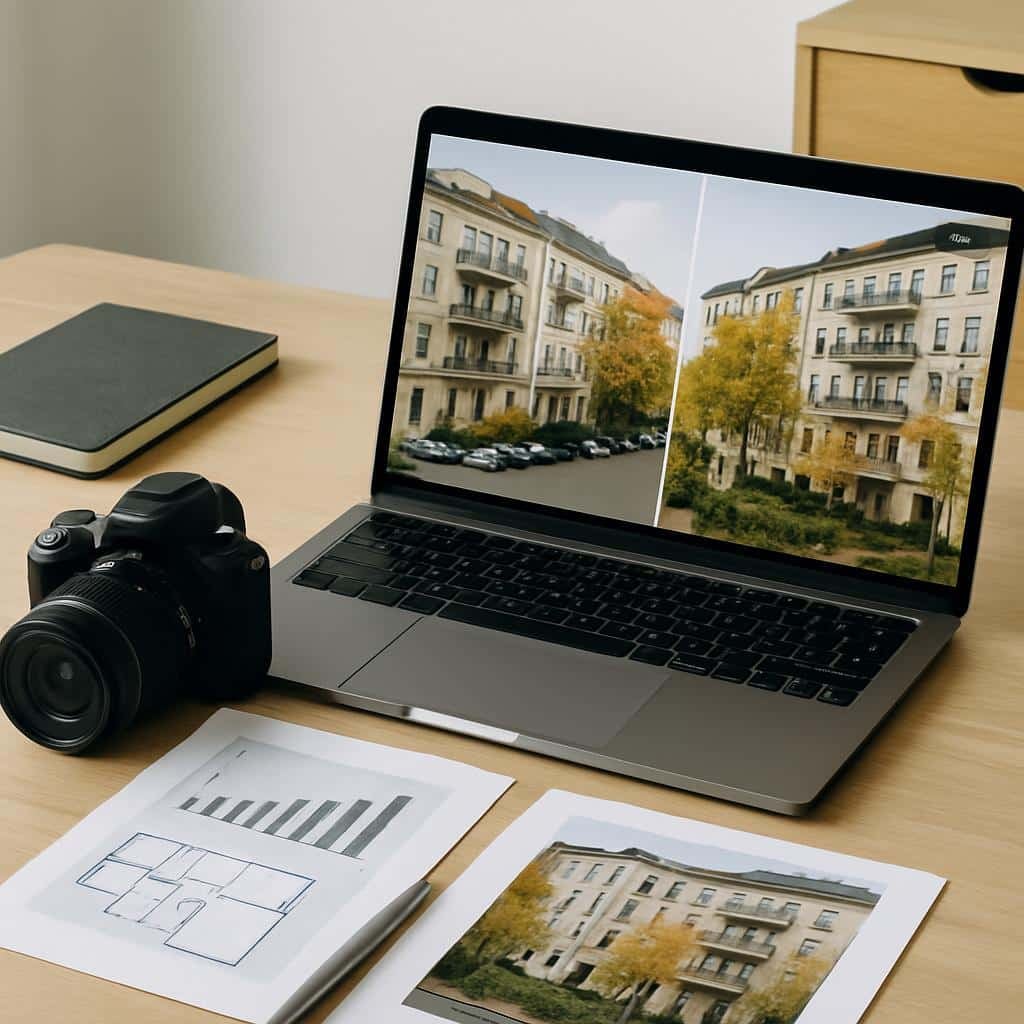
Why car-free photos perform better
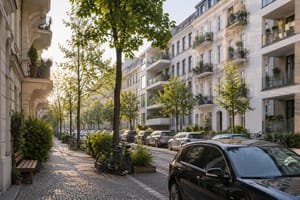
Cars obscure architecture, create visual clutter and dominate the image through reflections and number plates. Distant vehicles redirect the gaze back to what matters: proportions, materiality, lighting conditions, entrance area, and outdoor spaces. In internal analyses of real estate portals (assumption based on industry-standard A/B testing), they increase Click-through rate and Exposure duration with clear, unobstructed views, often 15–30 %. This has an impact on the time it takes to sell and on price negotiations – particularly in sought-after neighbourhoods such as Prenzlauer Berg, Charlottenburg or Kreuzberg.
So removes AI Berlin's street traffic from your images – cleanly and realistically
Modern tools combine semantic recognition (vehicles, number plates, faces) with content-based filling. A disciplined workflow is important to ensure that results remain realistic and that no artefacts are created.
- Recording quality Photograph in RAW format, use a slight telephoto lens (50–85 mm) to avoid distortion and pay attention to even lighting (morning/evening).
- Fix perspective Use a tripod; small series from an identical viewpoint make it easier for the AI to fill in occluded areas.
- Reference surfaces Create an additional image when the facade is temporarily car-free – the AI then has „real“ textures as a template.
- Selective Retouching Remove only temporary elements (cars, bins). Structural elements remain untouched.
- Fine-tuning After AI editing, pay attention to kerbs, shadow gradients and reflections in windows – typical places where retouching becomes noticeable.
For outdoor shots along busy streets (e.g. Frankfurter Allee, Kantstraße), a brief on-site plan is worthwhile: check for short no-stopping zones (if available), filming times with less traffic, and if in doubt, document two angles – one with AI-generated removal, one neutral.
Law, ethics and transparency: what is permitted – and what is not
The removal Temporary Objects such as cars are permissible as long as the substance of the property is not altered. ImportantNo structural defects should be „retouched“ (cracks, missing elements) and no visual relationships should be faked (e.g. a view of greenery that is actually blocked by a party wall). In brochures, a brief, transparent note such as „Vehicles digitally removed to make the facade visible“ is recommended – this builds trust.
Data Protection: Number plates and faces should be made unrecognisable anyway (data protection principle of data minimisation). AI workflows that completely remove cars usually achieve this automatically. Anonymise sensitive content (e.g. people at windows) or remove it for the final image.
Tools and team setup: Cloud, local, or service provider?
In-house AI (local) full data control, solid results, one-off setup. Suitable for agents with their own photo setup. Cloud Services: Fast, scalable, pay per image; check server location and order processing. Service provider highest consistency and quality control, sensible for premium objects or large volumes.
Quick calculation: 25 exterior shots per property, €2 per image in the cloud = €50. At 8 properties/month, the AI costs are approx. €400. If this reduces the marketing time by an average of 5 days (assumption), this regularly amortises itself through saved vacancy costs – quite apart from the image gain.
Quality Assurance: 7-Point Check before Publication
- Route planning: Are verticals straight, are alignments realistic?
- Textures Do the paving stones, joints, and plaster textures match where cars were parked?
- Light & Shadow Unified direction, no „hard edges“ without a cause.
- Reflections Are window and door reflections plausible (no car contours)?
- Contrast & Colour: Realistic tonal values, no exaggerated saturation.
- Transparency: Optional note in the exposé present.
- Version control Original file backed up, retouch clearly named (e.g. „_ret_“).
Case studies from Berlin: What's particularly worthwhile
Period building with stucco facade (Prenzlauer Berg) Cars conceal cornices and plinths – AI reveals details that enhance perceived value. Commercial property on main road (Charlottenburg): Removed vans show shop window width, frequency location remains documented by contextual images. New construction in the neighbourhood (Friedrichshain): Clearance of the driveway and green spaces make it look tidy; additionally, attach a neutral photo for location honesty in the exposé.
Conclusion: AI-powered Car-Free Property Photos are not „window dressing“, but a precise uncovering of the relevant qualities of a property. Those who market professionally in Berlin secure the decisive advantage in the first impression – measurable in click-through rates, enquiries and negotiation security.