
















Housing construction at the limit: Why Germany's construction sites are suddenly at a standstill
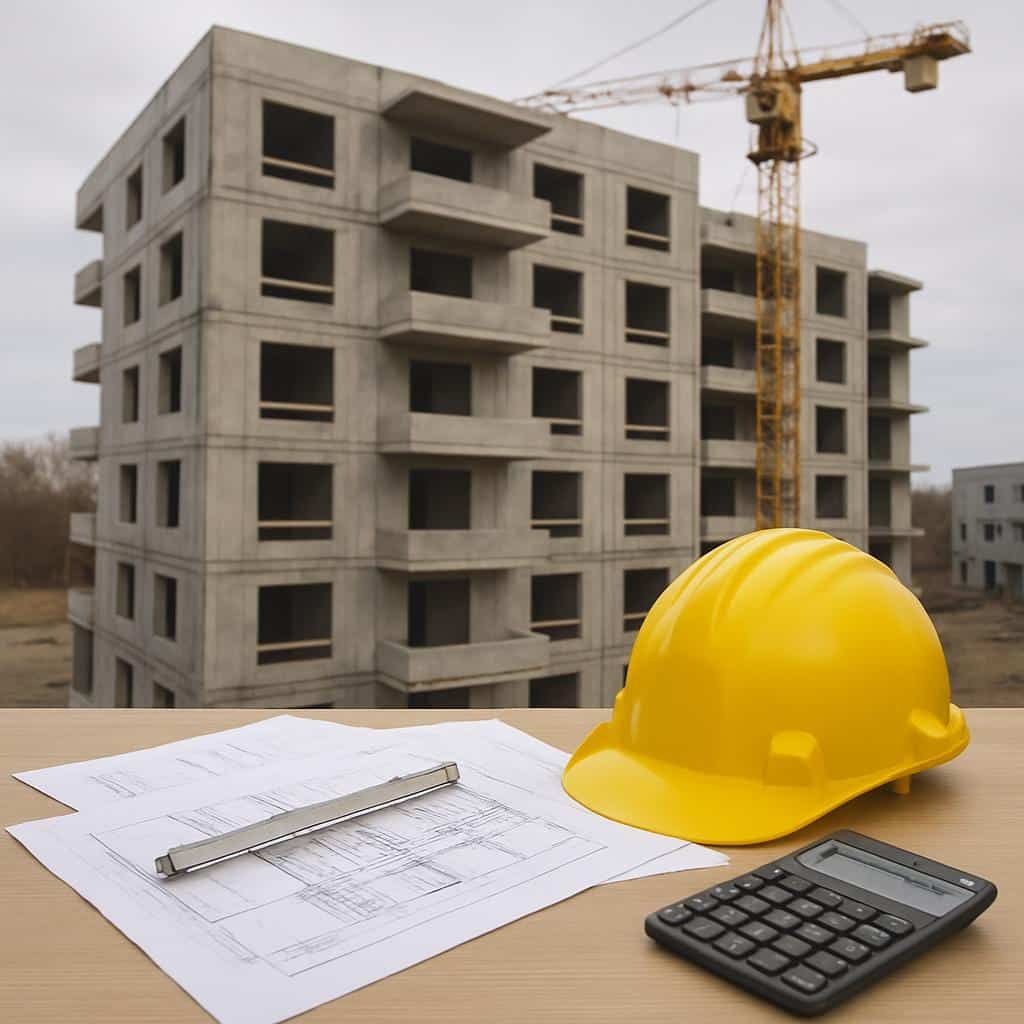
German housing construction is experiencing its toughest stress test in decades. Where just a few years ago cranes still dominated the sky, today there is radio silence: halted projects, delayed acceptances, property developers in difficulties. The causes lie in a rare simultaneity: a sharp rise in interest rates, high construction costs, stricter financing requirements and uncertain subsidy programmes. For buyers, owners and investors, this means that decisions need new diligence - and clear, reliable calculations.
Interest rate turnaround hits construction cost shock
Financing costs have risen sharply within a short period of time. While construction loans were often available at interest rates of 1-1.5 % in 2021, they have typically ranged between 3.5 and 4.5 % since 2023/24 (assumption: 10-year fixed interest rate, depending on credit rating and loan-to-value ratio). At the same time, construction costs in many trades have risen by 25-40 % since 2020 - driven by energy prices, material costs and wages. This double burden is tearing gaps in financing and upsetting calculations that once looked comfortable.
Financing quick check (simplified calculation example)
Loan € 500,000 | Initial repayment 2 %
At 1.2 % interest (2021): Annuity ≈ (1.2 % + 2.0 %) = 3.2 % → approx. €1,333/month
At 4.0 % interest (today): Annuity ≈ (4.0 % + 2.0 %) = 6.0 % → approx. €2,500/month
Conclusion: € +1,167 additional monthly charge. Check the loan-to-value ratio, amortisation and fixed interest rate again.
Permits stalled, property developers in a quandary
The pipeline is characterised by fewer property deals, postponed marketing starts and, in some cases, declining building permits. Many projects were calculated on the basis of old interest rate expectations. As soon as pre-sales stall or construction prices are subsequently adjusted, financing becomes tight. Banks demand higher equity ratios and stricter pre-sales quotas; property developers have to reschedule more frequently (e.g. changes of use, smaller floor plans, more serial construction). Result: Building sites are paused until additional financing or new partners are found.
Materials and skilled labour: bottlenecks remain structural
Even if supply chains are more stable than in 2022, prices for energy-intensive materials (e.g. insulation materials, cement) remain at a high level. At the same time, the shortage of skilled labour is exacerbating the situation: longer waiting times for finishing trades are leading to construction delays and cost risks. A calculated construction period of 14 months can actually turn into 18 months - with interest costs, rents and commitment interest as an „invisible“ cost block.
Typical errors & solutions on the construction site
- Error: Insufficient construction time and cost reserves. Solution: At least 10-15 % budget buffer; allow for a time buffer of +3-6 months.
- Error: Fixed-price contract without clear interfaces. Solution: Clarify service description, check index clauses, link milestones.
- Error: Subsidies thought too late. Solution: Check KfW/BEG early on (e.g. „climate-friendly new build“, QNG), align financing accordingly.
- Error: Only total price in view. Solution: Calculate life cycle costs (energy, maintenance reserve) and lettability.
Market impact: new construction scarcer, rents under pressure - opportunities in existing properties
If there is less new construction, the pressure on the rental market increases: demand meets too little supply. At the same time, new construction becomes more expensive for owner-occupiers and investors. Many buyers are therefore focussing on existing properties and renovations. Energy-efficiently modernised existing properties are often ready for occupancy more quickly, offer predictable costs and can score points with subsidy programmes and lower operating costs.
There are selective entry opportunities for investors: projects with planning permission but halted construction can be leveraged with strong equity - provided the location, product and marketing are right. Sellers who can offer refurbished, energy-efficient properties also benefit. Here, buyer demand remains solid if price and quality match.
What builders, buyers and owners should do now
- Making financing robust: Extend the fixed interest rate, secure special amortisation clauses, compare offers; loan-to-value ratios below 80 % often lower the interest rate.
- sharpen contracts: Fixed price only with clear service descriptions; check default rules, warranty and securities.
- Use funding strategically: KfW new-build funding (e.g. climate-friendly new build, QNG) or renovation funding; check combination with regional programmes.
- Check technical quality: External construction supervision, early-phase technical building services consulting, read EnEV/GEG certificates carefully; simulate later energy and operating costs.
- scenarios: Sensitivity to interest rates (+1 % point), construction costs (+10 %) and construction time (+6 months) - does the calculation hold up?
Concrete example: Purchase decision in a reality check
Assuming a new build costs €6,000/m², 90 m² = €540,000. At 4.0 % interest and 2 % amortisation, the annuity would be approx. 2,700 €/month (excluding utilities). A comparable, well-renovated property at €4,800/m² costs €432,000. Even with €80,000 for refurbishment, the sum remains below this. Also factor in the energy costs (e.g. heat pump vs. gas) and the tax treatment (when renting) into the decision. Conclusion: It is not the „new build“ per se, but the sum of purchase, operation, subsidies and rentability that is decisive.
Note: Figures vary from region to region; examples are for guidance only.
Outlook: What is turning the situation around?
A slight easing of interest rates, reliable funding frameworks and more standardisation (serial, modular construction) could boost residential construction again. Municipalities that speed up planning and approval processes will be the winners. In the short term, however, selectivity remains crucial: locations with stable demand, clear product positioning and low-risk construction and financing structures beat „wishful thinking“.
Would you like a professional assessment? We analyse your project, financing and marketing - fact-based, discreet and with an eye on your ROI. Arrange an initial consultation now: Contact form
Conclusion: Germany's building sites are at a standstill because interest rates, construction costs and risks have risen at the same time. Those who calculate carefully now, make contracts watertight and utilise intelligent subsidies can still make sound decisions - in both new and existing buildings. We support you with market knowledge, reliable valuations and marketing that delivers results even in difficult phases.