












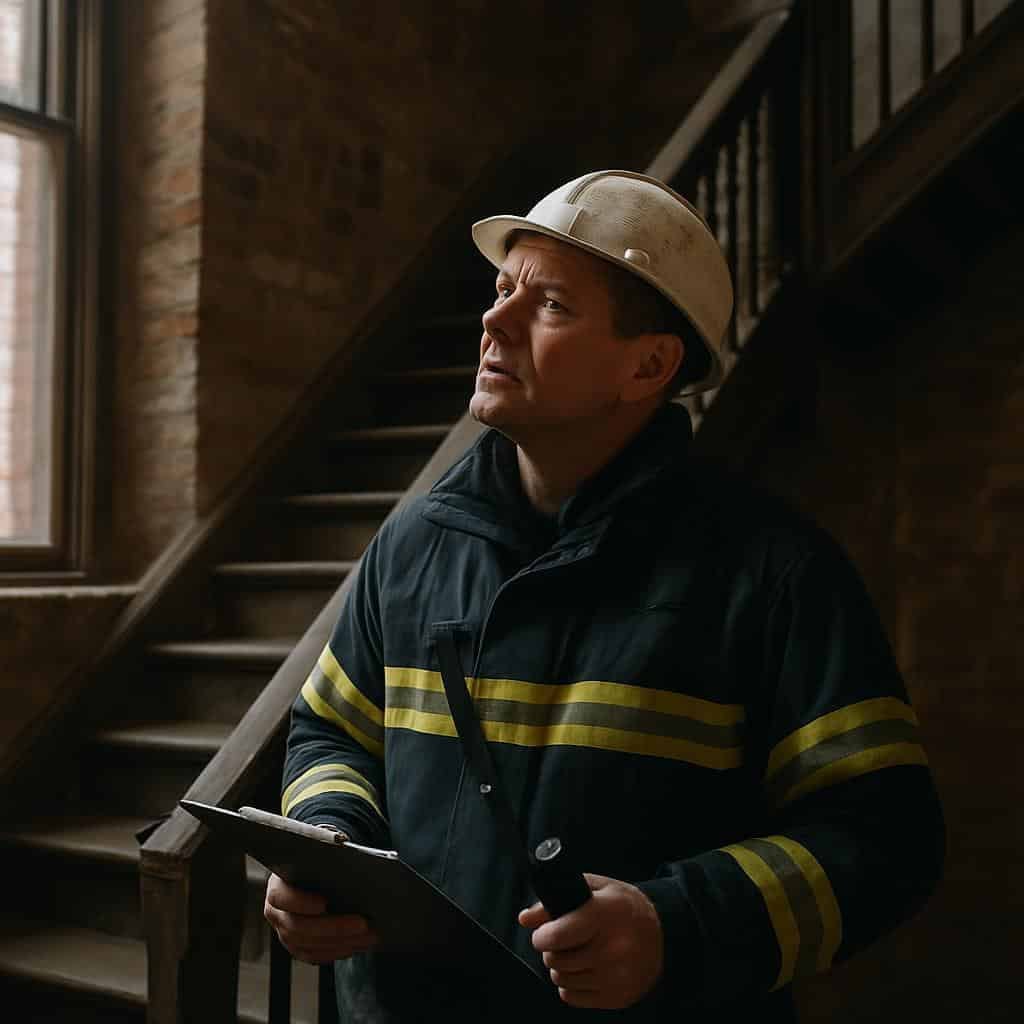



Fire protection in transition: Why old buildings now have to undergo a risk assessment
Germany's building stock is ageing - and with it the fire protection concepts. What was considered „adequate“ 20 or 30 years ago often no longer fulfils the requirements of insurers, authorities and tenants today. For owners, managers and investors, this means that an up-to-date Fire protection risk assessment is not a nice-to-have, but a tangible risk provision and a lever for value retention. This article shows what is important now, where typical pitfalls lie and which measures make economic sense.
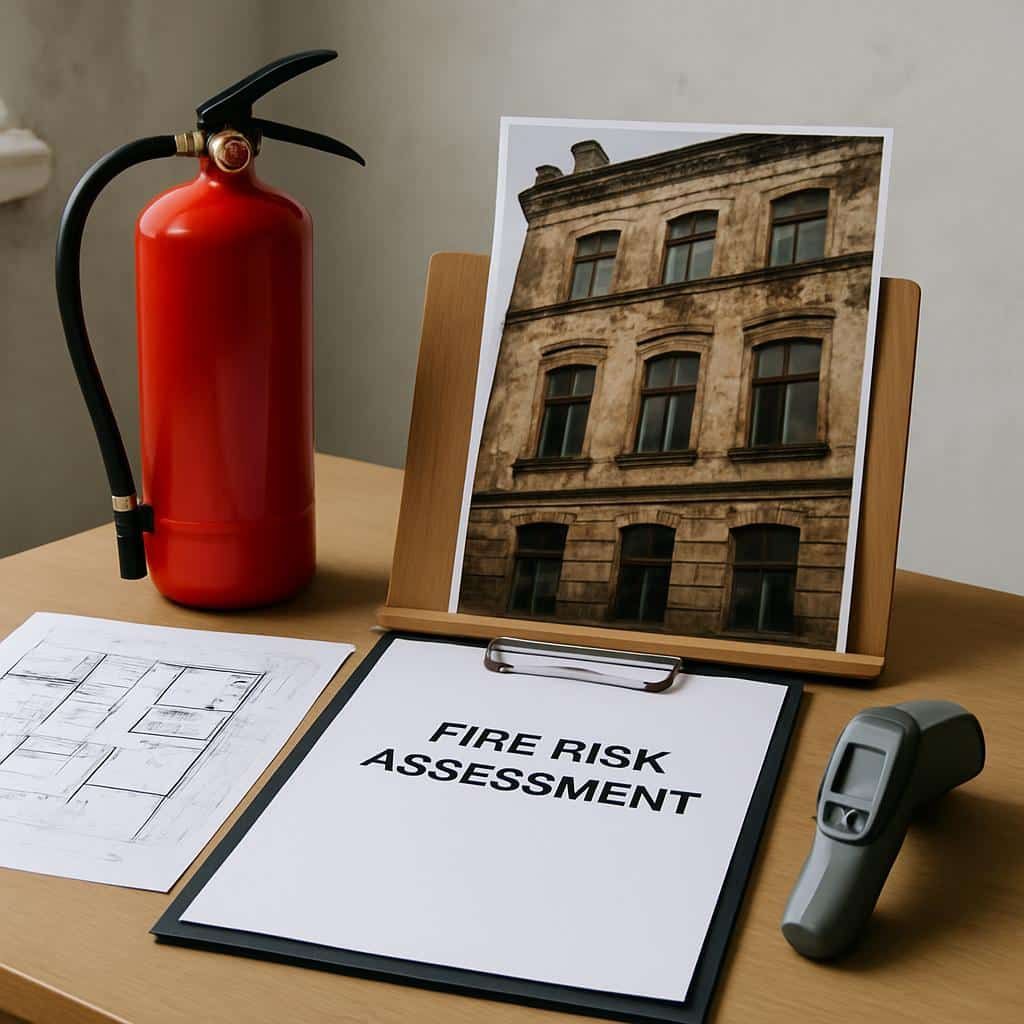
Would you like an initial inspection? We check your property for significant fire protection risks and show how these affect lettability and market value. Request an appointment now
The myth of „grandfathering“ - what really applies
It is often assumed that older buildings enjoy comprehensive grandfathering. It is true that there is protection for existing buildings - but it is not absolute. If utilisation, floor plans or fire loads change (e.g. due to new commercial tenants), it is partially waived. The authorities can also order retrofitting in the case of obvious hazards. Today, the focus is primarily on escape routes, smoke extraction and the fireproof separation of utilisation units. Those who act proactively here can avoid conditions, rental contract risks and insurance disputes in the event of a claim.
What inspectors and insurers expect today
Inspection engineers are guided by the applicable building law and recognised rules of technology. Insurers follow their own risk criteria, which are increasingly stricter than the minimum legal requirements. Typical inspection points in residential and mixed-use old buildings:
- Escape routes: Clear corridors, no fire loads in the stairwell, labelled exits, adequate lighting.
- Smoke alarms: In all bedrooms, children's rooms and corridors (mandatory retrofitting in all federal states; regular functional testing).
- Doors and bulkheads: Self-closing flat and stairwell doors with tested resistance (e.g. T30), professional cable sealing.
- Electrical installations: Visual inspection for overloads, temporary cables, missing RCDs in damp rooms.
- Fire extinguishers & maintenance: Locations easily accessible, signposting, testing usually every 2 years according to manufacturer/ASR.
- Documentation: Fire brigade lift/fire control for special buildings, escape and rescue plans, simple fire safety regulations Part A.
Typical risks in old buildings - and pragmatic solutions
Some patterns are repeated in existing buildings. The good thing is that many risks can be mitigated with a manageable budget.
- Locked/cluttered corridors: Decluttering, clear house rules, marking of escape routes; regular inspections.
- Old flat entrance doors: Retrofitting of self-closing fittings; if required, door replacement to T30 with all-round seal.
- Open cable trays: Retrofit penetration seals; use fire protection foam/ sleeves professionally.
- Electrical waste: Selective renewal (sub-distribution boards, FI/RCD), load separation for basement/basement; document measurement log.
- Smoke alarms without maintenance: Devices with 10-year battery, maintenance contract, annual test documentation.
5-minute quick check
- Is the stairwell free of bicycles/pushchairs?
- Does the front door and every flat door close automatically?
- Have smoke alarms been installed and tested in bedrooms and corridors?
- Is there a functioning fire extinguisher (with a valid sticker) on each floor?
- Can visitors find the exit without help (signage/emergency lighting)?
If you answer 2 or more points with „no“: action required.
Small measures, big impact - calculation examples
Example 1: Apartment block, 10 units. Retrofitting 20 smoke alarms with networked function and 10-year battery: approx. 1,600-2,000 euros including installation (assumption). Several insurers honour this with risk discounts or avoid surcharges; conservatively calculated 3-5 % on a building premium of 4,000 euros p.a. = 120-200 euros per year. Break-even after approx. 8-12 years - plus additional benefits: lower liability risk and better rentability.
Example 2: Staircase doors without self-closing mechanism. Retrofitting with tested closers and seals: 10 doors × 250-350 euros = approx. 2,500-3,500 euros. In addition to insurance acceptance, the risk of escape routes becoming smoky is reduced. Tenants and condominium administrators also rate the measure positively - experience shows that there are fewer days of vacancy when tenants change (assumption: -2 days of vacancy/year × 60 euros/day per unit = 1,200 euros/year savings across all properties).
Example 3: Selective electrical refurbishment. Sub-distribution board replacement, RCD retrofit, load management in the basement: 4,000-6,000 euros. Many damages in old buildings are electrical. An up-to-date test report reduces discussions in the event of a claim and can make special inspections by insurers unnecessary.
Common mistakes - and how to avoid them
- „Only the bare essentials“ without a concept: Better a short inventory with a list of priorities: immediately (danger), short term (insurance/authority), medium (increase in value).
- Unclear responsibilities: Administrator, owner, service provider - who checks what and when? Define intervals and documentation.
- Missing evidence: Without maintenance stickers and inspection logs, measures are considered „not available“ in case of doubt.
- Structural alterations without a view of smoke compartments: Every new opening, every cable breakthrough can compromise fire protection - apply penetration sealing directly.
- Forget communication with tenants: Brief information creates acceptance („Why no bicycles in the corridor?“) and reduces repetition efforts.
Note: This article does not replace legal advice. State building regulations, official requirements and recognised codes of practice (e.g. DIN, VDE) are authoritative. In case of doubt, specialised fire protection planning is recommended.
Quick check with a focus on market value
We combine fire protection risk analysis with an assessment of the impact on lettability, CapEx and exit capability. Contact us
Conclusion: reduce risk, secure value
The change in fire protection is real - and is affecting old buildings in particular. Those who check, prioritise and document now will reduce liability and costs, secure rental income and improve their negotiating position with insurers, authorities and buyers. With a clear roadmap, 80 % of the risks can be addressed with 20 % of the budget - quickly, effectively and verifiably.
We are happy to accompany you from the property inspection through the prioritisation list to implementation with reliable trades - always with an eye on return on investment and market value.
Start now with a non-binding initial assessment
We check your property and show you concrete, economical measures. Make an appointment