
















Charging stations in the basement - how e-mobility is now determining the attractiveness of residential locations
E-mobility has gone from trend to standard. For apartment blocks and residential complexes, the option is decisive, Charging stations in the basement The decision to install charging points is increasingly based on lettability, vacancy risk and long-term value development. Today, prospective tenants actively ask for charging points at the car park; owners pay attention to retrofittable infrastructure and professional load management. In short, charging infrastructure has evolved from a nice-to-have to a location factor - and smart owners are utilising this advantage in a targeted manner in their marketing.
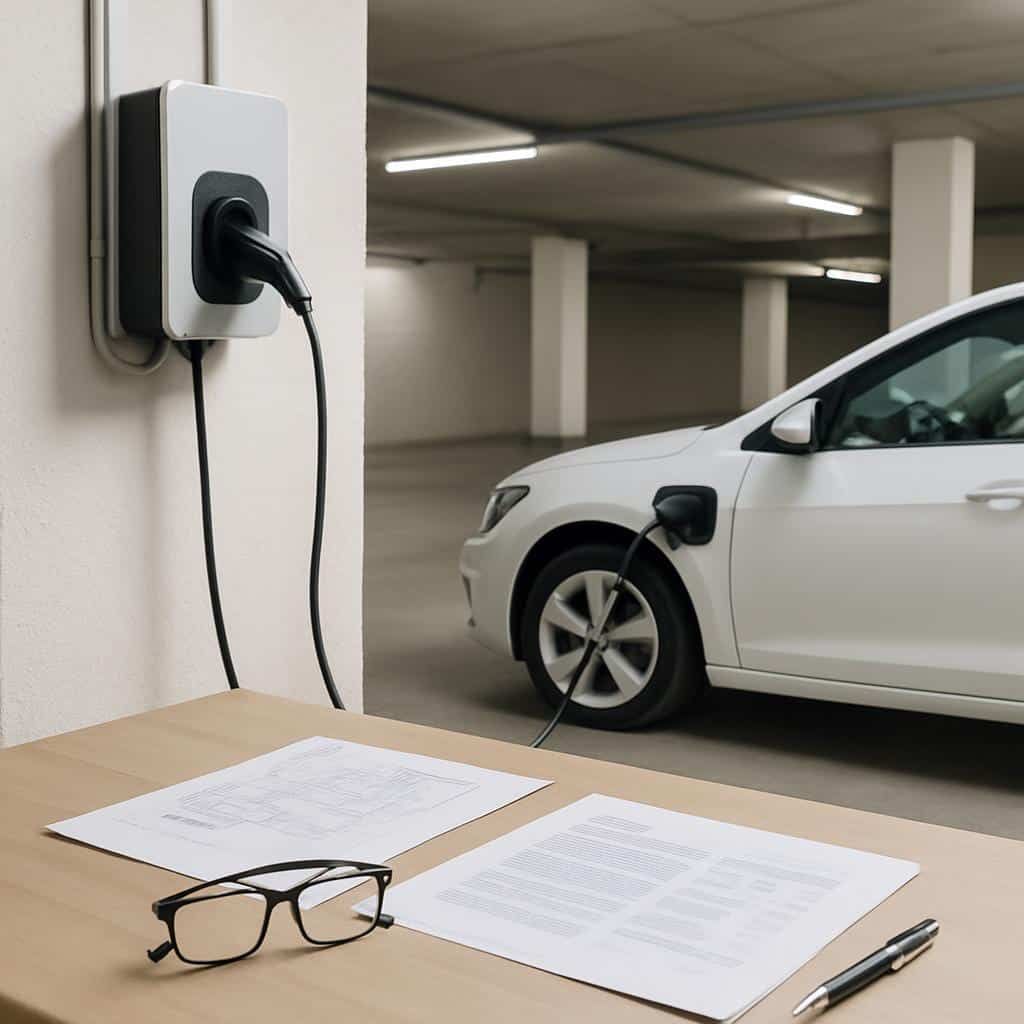
Demand drives returns: Why charging points make the difference
EV owners mainly charge at home - conveniently overnight. Those who do not have a parking space with charging facilities often switch to public charging points and assess residential locations more critically. In terms of letting, this means that flats with an allocated charging point often achieve faster lettings and lower tenant fluctuation (industry experience; regional variations possible). In sales, a Sustainable charging infrastructure the buyer's reach and reduces negotiation discounts for „investment backlog“.
Important: The mere connection of a single wallbox has a short-term effect, but real market acceptance is achieved through a scalable Infrastructure concept (busbar/backbone, load management, billing). This means that additional parking spaces can be connected in stages without having to make new investments each time.
Technology in the cellar: what really counts
- House connection & reserves: Is the connected load sufficient? Ideally, clarify a power reserve and connection commitment with the grid operator.
- Load management: Dynamic load management intelligently distributes available power to active charging points - crucial for costs and grid compatibility.
- Fire protection & paths: Align cable routes, escape routes, ventilation, fire loads with the fire protection plan; route cables in non-combustible systems.
- Humidity & temperature: Basements are technically suitable as long as IP protection types, condensate and distance to waste water drains are observed.
- Connectivity: Systems require LAN/mobile radio for billing and updates; provide repeaters/lines in the basement in good time.
- Billing/Calibration law: Choose charging solutions that measure in compliance with calibration law and bill on a user-related basis (RFID, app, cost centres).
- Scaling: Design the busbar or distribution cabinet so that additional spaces can be retrofitted without a construction site.
Practice: In existing buildings, it is often sufficient to phase-preserving 11 kW setup with dynamic load management. In new buildings, a continuous cable route with reserves for each parking space (empty conduits, numbered, documented) is recommended - this saves disproportionate construction costs later on.
Quick-Check charging power
Example: 10 parking spaces, 8 active vehicles at night, 11 kW wallbox each, house connection reserve 22 kW.
Without management: theoretical 88 kW demand - impossible. With dynamic load management: 22 kW / 8 = Ø 2.75 kW per car. In 10 hours of night charging ≈ 27.5 kWh per vehicle - sufficient for approx. 140-180 km (assumption: 15-20 kWh/100 km). Conclusion: For everyday profiles, the reserve is often sufficient instead of requiring expensive grid expansion.
Law, costs, funding: plan safely instead of discussing
In condominium owners' associations, there is a Entitlement to charging infrastructure (WEMoG, Germany). The WEG can regulate the execution and distribution of costs; a professional decision with a technical concept avoids disputes. In the rented property, the landlord has the freedom of design, but should choose a transparent metering and billing model (e.g. separate sub-metering point per user or backend billing via the operator).
- Steps for owners/managers:
- Needs assessment: parking spaces, user profiles, expansion target (e.g. 30-50 % of spaces by 3 years).
- Define the meter concept: Direct metering, sub-metering or backend billing.
- Create load and fire protection concept; coordinate with grid operator/chimney sweep/fire protection.
- Obtain offers from specialised companies on the basis of a standardised specification.
- Check subsidies/grid fee options (varies from region to region; enquire at an early stage).
- Contractually stipulate user regulations, liability, maintenance and access rights.
Cost framework (approximate values, depending on location): Individual wallbox from approx. €1,200-2,000 plus installation; backbone/power rail, network technology and fire protection can amount to €300-1,000 per parking space in the expansion package. Operation (backend, service) usually in the low double-digit range per month and charging point.
Typical errors & solutions
Error: Point solution without scaling.
Solution: Plan backbone + reserved seats per stage.
Error: No connectivity in the basement.
Solution: Plan LAN/4G repeater in advance, function test before commissioning.
Error: Oversized mains connection.
Solution: First check load management, then expansion; use measurement log of peak loads.
New construction vs. existing buildings: two paths to the same goal
New building: Installation shafts, empty conduits to every parking space, sufficient transformer capacity and a future-proof backend from day one. Additional costs during construction are significantly cheaper than later core drilling and fire barriers.
Inventory: Prioritise a Scalable basic development (e.g. a ring main in the basement) and equip parking spaces as required. In many cases, network management allows you to get started without expensive house connection conversions - what is important is proper documentation and coordination with the network operator.
Promotion: Programmes change regularly. Check municipal subsidies, network operator bonuses and tax aspects (e.g. amortisation, allocation of operating costs, if permitted). A quick subsidy check before awarding the contract often saves four-figure sums.
Measurably utilise marketing advantage
The following applies to the exposé: present the charging infrastructure clearly, objectively and verifiably - number of charging points, power, load management type, billing, expansion options. A tidy, signposted charging area with good lighting increases the feeling of quality during the viewing. In B and C locations, a high-quality charging infrastructure can partially compensate for the location disadvantage; in A locations, it secures the expectations of modern tenants and buyers.
Our conclusion: Charging stations in the basement are no longer an experiment, but a sound lever for lettability, value stability and ESG compliance. Structured planning today prevents expensive detours tomorrow - and positions your property visibly ahead of the market.
Do you need a site-specific assessment or a marketing plan? We examine the potential, costs and marketing advantages of your property - neutral, structured, tried and tested. Contact us