















BIM conquers old buildings: how 3D laser scans make renovations faster and more precise
Anyone renovating an old building is making decisions worth millions. Unexpected leaks, concealed pipes or unclear statics cost time, money and nerves. This is exactly where Building Information Modelling (BIM) in combination with 3D laser scans precise inventory data, clean planning, fewer supplements. As a broker and project partner, we use this methodology to recognise risks at an early stage, make budgets resilient and increase value potential transparently.
What is BIM in existing buildings - and why it is more than just a 3D model
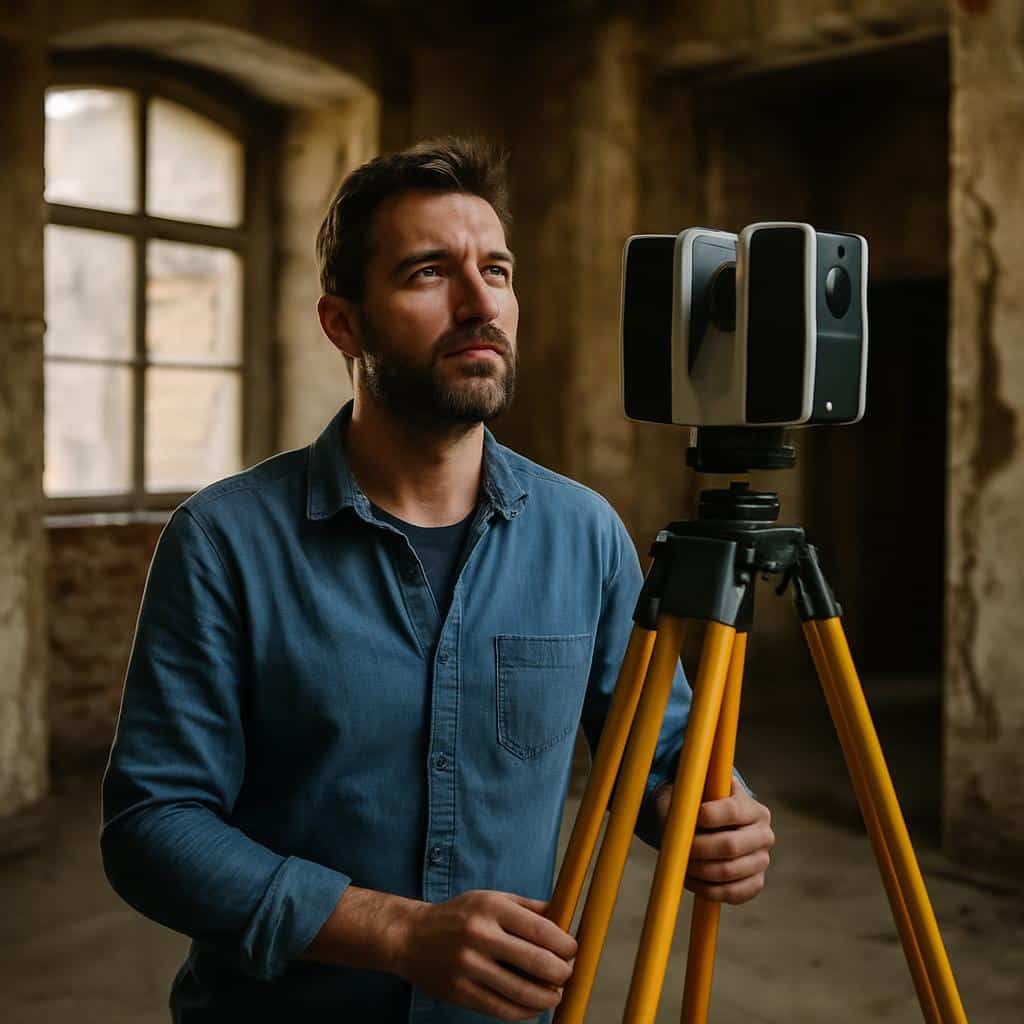
During the as-built survey, rooms, components and installations are measured with millimetre precision using a laser scanner. The result is a dense Point cloud, which are converted into a digital measurement and then into a BIM model is transferred. Unlike traditional 2D plans, BIM not only depicts geometry, but also properties: Wall structures, material, year of construction, damage status, quantities. This link makes construction costs, construction time and processes Simulatable - an enormous advantage in old buildings, where hardly any two ceiling heights are the same.
Precision beats gut feeling: measurable benefits in old buildings
- Reliable measurement: Deviations of 3-5 cm per room quickly add up. The laser scan provides a as-built instead of a „pi times thumbs“ plan.
- Collision check: Will the new lift shaft fit? Collision checks in the BIM avoid expensive surprises in the extension.
- Cost transparency: Quantities (e.g. m² of plaster, metres of pipes) are determined automatically - the basis for reliable quotations.
- Schedule and construction process reliability: Precise component statuses help to synchronise trades sensibly and avoid idle times.
- Documentation for sales and financing: A digital inventory model increases traceability for banks, buyers and valuers.
Quick check: Does a 3D laser scan pay off?
Assumption: 2,000 m² living/usable space, scan + BIM model LOD 200 for €2.50-4.00/m² = €5,000-8,000. If this avoids just 1% construction cost errors for a refurbishment volume of €1.2 million, €12,000 is saved. Conclusion: Even small planning errors, which become visible thanks to the scan, refinance the costs significantly.
From scan to decision: the proven 3-step workflow
1) 3D laser scan on site: Scanner stations record rooms, stairwells, attics. Duration 1-3 days depending on the size of the property. Result: georeferenced point cloud, accurate in every detail, even in niches and slopes.
2) Modelling of the existing building (BIM): A parametric model (typically LOD 200-300) is created from the point cloud. Walls, ceilings, windows and pipes are created as components with properties - the basis for cost estimates and variants.
3) Evaluation and comparison of variants: Quantity determination, areas according to DIN, energy checks (assumption: U-values from component structures), collision and sequence planning. Changes are maintained centrally in the model - all plans and lists are updated consistently.
Practical example: Wilhelminian-style apartment block with extension
In an old building in Berlin (built around 1905), floor plans were to be modernised and pipes renewed. Some of the classic plans deviated 6-8 cm from reality; ceiling heights varied between 2.92 m and 3.08 m. The Laser scan uncovered leanings and a concealed joist that would have affected the planned kitchen opening. In the BIM model the opening was relocated, the installation shaft narrowed and the fire protection properly verified. Result: no demolition stoppage, 3 weeks time saved, risk of additional work reduced by approx. 1.5% (assumption based on comparative offers).

Typical errors - and our solution
- Scan too late: Only recorded after the start of construction? Solution: Scan before planning, second recording after demolition if required.
- False accuracy: Only LOD 100 commissioned, but detailed expansion planned. Solution: Define LOD to suit the project objective (e.g. LOD 300 for building services).
- No tolerances: Old buildings thrive on deviations. Solution: Store tolerance fields in the model; integrate finishing trades at an early stage.
- Data islands: IFC is missing, only PDFs. Solution: Agree open formats (IFC), define clear data transfers and responsibilities.
Tips for owners, project developers and administrations
- Sharply define scope: Which components need to be modelled? Is LOD 200 sufficient or is LOD 300 necessary for building services?
- Ensure quality: Random sample measurement in the property against a point cloud (e.g. 10 rooms) - document deviations and readjust.
- Check quantities early: Mirror plaster, screed and surface quantities against cost estimates; escalate deviations >2-3% immediately.
- Freeze planning status: Define milestones (e.g. 30/60/90%); only use tested models for tenders.
- Legal & Data Protection: Clarify access rights for inhabited buildings; only publish sensitive areas anonymously.
Minimise risks, secure value
Digital inventory models Reduce the number of amendments, speed up approvals and create trust with buyers, banks and funding agencies. In old buildings, where every detail counts, the 3D laser scan provides the factual basis: from floor plan optimisation to material quantities and schedules. The result is more precise offers, shorter construction times and predictable returns.
Next step: We check whether a scan and BIM model is worthwhile for your property - transparently, quickly and reliably. Request an initial consultation now
Do you want to safely maximise the potential of old buildings, reduce additional work and meet deadlines? We support you from the initial assessment through to implementation - with clear processes and reliable partners. Contact us and put your project on solid data.